Your Grocery and Cold Storage Sites Are Overpaying for HVAC Energy Every Month — and We Now Fix It Autonomously, at Scale

How can grocery and cold storage operators cut HVAC energy costs across a fleet without new hardware?
Key Takeaways
Axiom Cloud's new HVAC Optimization module finds and fixes rooftop unit (RTU) inefficiencies — scheduling drift, units fighting each other, full-capacity operation in empty buildings — directly through your existing building management system, with no action required from your team.
Field validation across 17 facilities and 40 rooftop units, backed by 3,400+ system-years of HVAC operating data, shows ~11% energy savings on RTU-related consumption and a 9x return on investment (Axiom Cloud field data, 2026).
Deployment is software-only and fully remote: no hardware, no sensors, no truck rolls, no capital expenditure — a live portfolio dashboard in days, not months.
Every optimization is checked against comfort thresholds before it is applied and reviewed by Axiom's HVAC experts; your team keeps full visibility, an audit trail, and one-click rollback on any change.
Picture two rooftop units on the same building. One is heating. The other is cooling. They run against each other for hours — burning double the energy without moving the space temperature by a single degree. No alarm fires. No dashboard flags it. It just shows up as a slightly higher utility bill that nobody has time to investigate.
That is not an edge case. It is the quiet, structural reality of running HVAC across a fleet of stores — and it compounds every month, in every building, on the energy line item most operators have given up on.
📊 Stat: Heating, cooling, and ventilation account for roughly 34% of all energy consumed in U.S. commercial buildings — the single largest end-use category (U.S. EIA, Commercial Buildings Energy Consumption Survey, 2018).
Why does rooftop HVAC waste never trigger an alarm?
If you run energy, facilities, or operations for a grocery chain, HVAC is probably not what keeps you up at night. Refrigeration, food safety, AIM Act deadlines, and a maintenance backlog across a network of stores crowd it out. HVAC falls to the bottom of the list — not because it doesn't matter, but because everything else is louder.
Meanwhile your rooftop units quietly bleed energy across the portfolio, and the losses aren't coming from exotic failures. RTUs routinely run at full capacity during off-hours, conditioning an empty building as if it were full of shoppers. Adjacent units work directly against each other. Schedules drift out of alignment within weeks of being set. None of it triggers an alarm, because none of it is a "failure" in the way a dead compressor is — it's just waste, behaving normally.
The reason it persists isn't a lack of technology. It's a lack of attention. Nobody has the bandwidth to go store-by-store, unit-by-unit, optimizing a fleet of RTUs — and even if they did, conditions change constantly, so any improvement drifts back almost immediately. That is the problem we built the HVAC Optimization module to solve.
What does the HVAC Optimization module actually do?
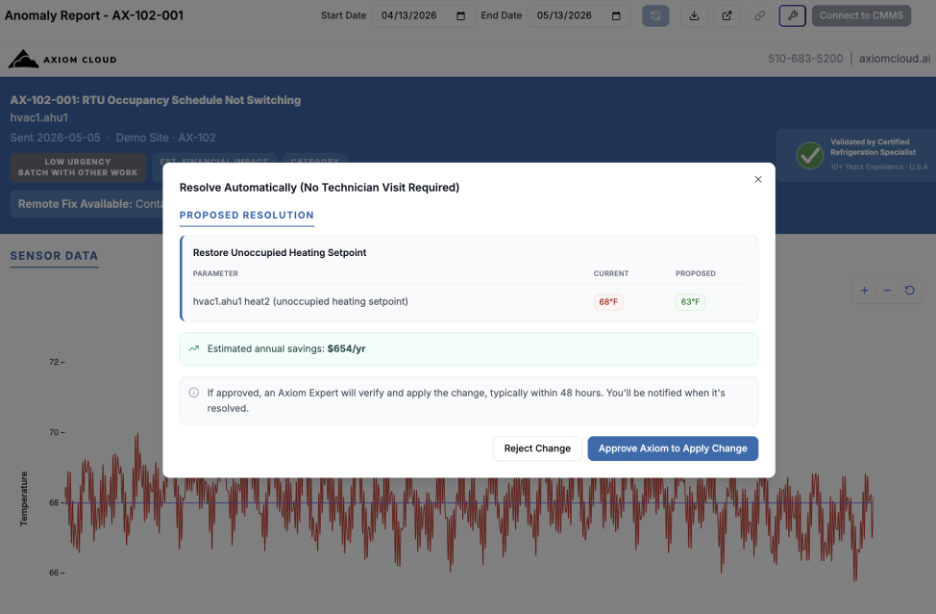
HVAC Optimization is a new module within the Axiom Cloud platform that identifies inefficiencies across your rooftop unit fleet — scheduling drift, units working against each other, systems running at full capacity when they shouldn't be, and more — then implements the fixes directly through your existing building management system and controllers, without requiring any action from your team.
For existing Axiom customers, this is already the platform embedded in your facilities. There is no new integration, no new vendor relationship, and no new operational burden. The systems are connected, the data is flowing, and the module simply expands what the platform does with it. For operators new to Axiom, deployment is fully remote and software-only — going live in days rather than months, the same way Axiom already scales without ripping and replacing your existing systems.
How much does autonomous HVAC optimization actually save?
Based on field validation across 17 facilities and 40 rooftop units, and backed by more than 3,400 system-years of real-world HVAC operating data, we are seeing approximately 11% in energy savings on RTU-related consumption — quantified per store, with full transparency into the methodology. At current levels that translates to a 9x return on investment on energy spend alone, before counting avoided maintenance or comfort complaints. We expect the numbers to improve as the engine matures across more store formats and climates.
Now do the math. Run it on a mid-size fleet: 150 stores, each spending roughly $30,000 a year conditioning the building with rooftop units — a conservative figure for a supermarket. That's $4.5 million a year in rooftop energy. An 11% reduction is roughly $495,000 a year — and it recurs with nothing to install, no one pulled off their day job to manage it. And occupant comfort is never the tradeoff: every optimization is evaluated against comfort thresholds before it is applied, so a change that would compromise how a store feels to customers or staff simply does not get made.
Is fully autonomous the same as unsupervised?
No — and the distinction matters. The module is autonomous in that Axiom identifies inefficiencies and implements optimizations directly, without spinning up action items or resolution workflows for your team. But autonomous is not the same as unsupervised. Every optimization is reviewed by Axiom's team of HVAC experts before it is applied, and your team retains full visibility and control — the ability to review, adjust, or roll back any change at any time, with a complete audit trail of every optimization applied across your fleet.
Your team sees everything. They just don't have to do anything.
What does software-only deployment require from your team?
Our grocery customers have made it crystal clear: they do not want to rip out and replace working systems. Your building management system is already in place, your controllers are already connected, and your infrastructure is already generating the data we need.
HVAC Optimization deploys entirely through software — no new hardware, sensors, or on-site installations. Deployment is fully remote, goes live in days rather than months, and scales across your entire store portfolio from a single platform: no truck rolls, no site visits, no capital expenditure. It's the same deployment model that lets Axiom scale across thousands of grocery refrigeration sites quickly. We meet you where you are, rather than asking you to make painful changes to your infrastructure or your processes.
Why this, why now?
Your energy and facilities teams are already maxed out managing refrigeration, and HVAC — despite being one of the largest energy line items in any grocery operation — rarely gets the attention it deserves, because there is always something more urgent. The HVAC Optimization module was built so your team doesn't have to choose. The savings happen on their own while your people stay focused on the work that actually needs them.
The same platform already identifying refrigerant leaks weeks before alarms fire, diagnosing maintenance issues before they become emergencies, and optimizing refrigeration energy across the enterprise now covers HVAC too — using the same approach, the same deployment model, and the same team.
Questions to ask before you buy any HVAC optimization solution
Does it require new hardware, sensors, or on-site installation — or does it work through the controllers and building management system you already have?
Is it actually autonomous, or does it just generate another queue of work orders and recommendations for your already-stretched team to action?
Is every automated change reviewed by a human expert before it's applied, and can you audit and roll back any optimization?
Are energy savings quantified per store with transparent methodology, or asserted as a vague portfolio-wide percentage?
How is occupant comfort protected when setpoints are adjusted automatically?
The waste is already on your bill. The fix shouldn't be another project.
If your stores are overpaying on HVAC energy — and statistically they almost certainly are — the missing piece isn't another dashboard or a consultant's report that drifts out of date in a month. It's a system that identifies the waste, fixes it autonomously, and keeps fixing it as conditions change. That is what we built.
See what HVAC Optimization would find across your portfolio — explore the HVAC Optimization module or reach out to the team.
About the author
Matt Nigro is a Senior Product Engineer at Axiom Cloud, where he leads development of the HVAC Optimization module. He holds an M.S. in Aerospace Engineering and has spent his career applying control systems, thermodynamics, and machine learning to commercial refrigeration and HVAC. At Axiom, he re-engineered the company's refrigeration optimization platform to control variable-frequency and unloader compressors, built the machine-learning and data infrastructure behind its analytics, and has helped launch product modules spanning early leak detection, predictive maintenance, and energy efficiency across grocery and cold-storage fleets. Before Axiom, he led the design and patenting of clean-energy refrigeration systems at Carrier and is a named lead inventor on refrigeration patents in the United States, Europe, and China.
Sources:
1. Use of energy in commercial buildings — U.S. Energy Information Administration, Commercial Buildings Energy Consumption Survey (2018).
2. Upgrade your RTUs and reduce energy use by 30 to 50% — U.S. Department of Energy, Better Buildings Initiative.
3. HVAC Optimization module — Axiom Cloud, 2026.


Comments