Refrigerant Leak Detection in Commercial Refrigeration: When the Quarterly Inspection Becomes the Compliance Risk

Updated: Aug 20
AIM ACT | SUBPART C | MAY 2026

Does Your Refrigerant Leak Detection System Actually Qualify Under the AIM Act — and What Happens If It Doesn't?
Key Takeaways
The AIM Act's ER&R Rule (40 CFR §84.108) requires Automatic Leak Detection on every commercial refrigeration or industrial process appliance with ≥1,500 lbs HFC charge — new systems by January 1, 2026; existing systems installed 2017–2025 by January 1, 2027; pre-2017 equipment grandfathered.
The EPA's official Technical Support Document (September 2024) names Axiom Cloud as one of only four manufacturers of commercially available indirect ALD products in the United States — alongside Copeland, Matalex, and Hussmann/Panasonic.
Indirect ALD monitors the whole refrigerant circuit — including portions outside enclosed spaces — coverage that point-of-leak gas sensors cannot match.
Operators on quarterly manual inspection cycles can have a leak running undetected for 90 days; Axiom Cloud's refrigeration software typically surfaces leak events within 1–14 days, with a validated 9% false-positive rate across a 100+ store U.S. customer.
Each missed or late response to a leak alert can trigger fines up to $59,114 per day, per violation — and the EPA's May 21, 2026 reconsidered Technology Transitions Rule did not change the ALD deadline.
📊 Stat: Under AIM Act Subpart C, commercial refrigeration systems holding ≥1,500 lbs of HFC refrigerant must have ALD installed by Jan 1, 2026 (new systems) or Jan 1, 2027 (existing 2017–2025 systems). Penalties reach $59,114/day per violation. (Source: epa.gov)
What if the quarterly leak inspection your refrigeration team has run for years is now the thing creating compliance risk?
That is the uncomfortable question every facilities and refrigeration leader at a large grocery or cold storage operator should be asking right now. The AIM Act's ER&R Rule has been fully in effect since January 1, 2026 — and unlike Subpart B (Technology Transitions, just relaxed in EPA's May 21 reconsidered final rule), Subpart C did not move. Automatic Leak Detection is required on appliances with ≥1,500 lbs of HFC charge. Manual quarterly inspections alone no longer satisfy the rule for those systems.
In this guide:
What the AIM Act actually requires for refrigerant leak detection
What "Automatic Leak Detection" actually means in practice
Why point-of-leak sensors alone fall short in commercial refrigeration
How whole-system refrigerant leak detection works
Why the EPA named Axiom Cloud one of four indirect ALD systems in the U.S.
Now do the math: what one false alarm actually costs
Why the May 21, 2026 TT reconsidered rule did not change the ALD deadline
When is refrigerant leak detection required? (AIM Act deadlines)
Questions to ask your ALD vendor
FAQ
What the AIM Act actually requires for refrigerant leak detection
The American Innovation and Manufacturing (AIM) Act of 2020 authorized EPA to manage HFC use and reuse. The resulting Emissions Reduction and Reclamation (ER&R) Rule under 40 CFR Part 84 Subpart C is now fully operative. Two provisions matter for leak detection.
§84.106 leak repair applies to any commercial refrigeration or industrial process appliance containing ≥15 lbs of HFC (or substitute with GWP >53). When the annual leak rate exceeds the threshold — 20% for commercial refrigeration, 30% for IPR, 10% for comfort cooling — leaks must be repaired within 30 days. §84.108 requires Automatic Leak Detection on every commercial refrigeration or industrial process appliance with full charge ≥1,500 lbs HFC. That threshold captures most large supermarket rack systems, distribution-center refrigeration, food-manufacturing process refrigeration, and the ammonia/HFC-cascade or HFC-only cold-storage warehouses that have been the workhorses of the U.S. cold chain since 2017. Pre-2017 equipment is grandfathered; existing 2017–2025 systems must comply by January 1, 2027.
These rules are independent of Clean Air Act Section 608, which still applies to refrigeration appliances containing ≥50 lbs of regulated refrigerant.
What Does "Automatic Leak Detection" Actually Mean Under the AIM Act?
What does "Automatic Leak Detection" actually mean in practice?
ALD is a system that monitors a refrigeration appliance for refrigerant loss and alerts the owner or operator automatically — without requiring scheduled manual inspection. EPA recognizes two categories.
Direct (vapor) ALD uses point-of-leak gas sensors placed near compressors, evaporators, condensers, and high-leak-potential locations. Per §84.108(f), sensors must detect ≥10 ppm vapor and alert at ≥100 ppm.
Indirect (calculated) ALD monitors the behavior of the refrigeration system — temperatures, pressures, receiver levels, compressor runtime, condenser heat rejection — and detects refrigerant loss through performance anomalies. Per §84.108(g), an indirect system must alert when measurements indicate refrigerant loss of 50 lbs or 10% of full charge, whichever is less.
The EPA's Technical Support Document notes that "newer indirect ALD systems often use multiple parameters working in tandem, such as temperature, pressure, liquid levels, etc., to help identify potential leaks" — and that "indirect ALD systems that rely on multiple data points are more accurate in identifying leaks, whereas systems utilizing only a single data point do not identify leaks as quickly or effectively."
Why Do Point-of-Leak Gas Sensors Alone Fail to Satisfy AIM Act Compliance?
Why point-of-leak sensors alone fall short in commercial refrigeration
A single 50,000 sq ft supermarket has hundreds of brazed joints, valve stems, fittings, and mechanical connections. A sensor near each one is not physically or economically practical at fleet scale. The EPA's TSD acknowledges the gap directly: indirect ALD "monitor[s] all portions of a refrigerant-containing appliance, including portions of an appliance that are located outside of an enclosed space." Direct sensors cannot.
Many facilities leaders are shocked to learn that installing direct ALD gas sensors does not exempt them from quarterly manual leak inspections under Section 608. The rule is explicit: "An owner or operator is required to inspect all portions of a refrigerant-containing appliance not monitored by an ALD system." Rooftop condensers, underground lines, overhead piping, non-enclosed sales floors — if a sensor isn't there, the inspector still has to be. (See: The Automatic Leak Detection Compliance Paradox for the full sensor-only liability breakdown.)
There is also a hidden cost most operators don't see until the bill arrives. PPM sensors must be audited and calibrated annually. A proper fleet-wide calibration program costs roughly the same as Axiom Cloud's entire annual subscription — before the upfront sensor hardware is counted. When operators skip calibration to control cost, drift takes over: alerts begin firing on ambient gases or HVAC airflow rather than actual refrigerant loss. That is the mechanical root cause of the thousands of false positives per month some sensor-only deployments generate — and the alert fatigue that follows when operators learn to tune everything out. (Is whole-system ALD cheaper than mandatory manual leak inspections?)
How whole-system refrigerant leak detection works
Cloud-based indirect ALD connects to a refrigeration system's existing controls — Copeland E2/E3, Danfoss AK-SM, Carel, Emerson — and ingests the data the controllers already produce. AI models learn each circuit's normal operating envelope and detect when performance signatures consistent with refrigerant loss appear. The EPA TSD describes the data set used by indirect ALD systems as "receiver levels, pressures, temperatures, condenser heat rejection calculations, weather data, heat reclaim status, condenser split status, and other available data (Axiom Cloud, 2024)" — language drawn from Axiom Cloud's 2024 public comment.
The operational difference is straightforward. A facility on a quarterly manual inspection cycle can have an active leak running for up to 90 days before anyone notices. Axiom Cloud's Early Leak Detection module typically surfaces leak events within 1–14 days. Across a U.S. customer with more than 100 store locations, Axiom Cloud's confirmed false-positive rate is 9% — validated using observed refrigerant refill events and direct customer feedback. More than nine in ten alerts represent a real leak event requiring action.

Like any indirect system, cloud-based monitoring identifies that a leak is occurring before pinpointing where. A technician still conducts a targeted inspection to locate the specific failure point. The advantage is catching the leak early, when it is small — before the annual leak rate threshold has been crossed.
Worth saying plainly: liability does not transfer to the vendor. Indirect ALD does not "handle your compliance." It produces the audit-defensible evidence — calendar-year-stamped alert logs, calibration records, repair documentation — that your team needs when the EPA, CARB, or NYSDEC asks for it.
Why the EPA named Axiom Cloud one of four indirect ALD systems in the U.S.
The EPA's official Technical Support Document on Automatic Leak Detection (Docket EPA-HQ-OAR-2022-0606-0167, September 2024) states: "EPA is aware of four manufacturers with commercially available products in the United States — Axiom Cloud, Copeland (formerly Emerson Climate Technologies), Matalex, and Hussmann/Panasonic." Axiom Cloud is cited four times across Sections 2.2 and 2.3. The document references Axiom Cloud's 2023 public comment as the technical evidence base for multi-parameter indirect ALD best practice, and notes that as of 2023, Axiom Cloud products were installed in 242 grocery stores and cold-storage facilities across the United States.
This is not a vendor directory listing. It is the EPA's own regulatory analysis underpinning the AIM Act ALD mandate — the document operators, auditors, and compliance consultants reference when defining what qualifies.
EPA also writes that indirect ALD systems "are allowed under existing leak repair programs, such as the CARB RMP, and can also be used as a compliance option in lieu of leak inspections under CAA section 608." Indirect ALD can replace mandatory manual inspections — not supplement them.
Now do the math: what one false alarm actually costs
Every ALD alert opens a regulatory response window. CARB requires operators to respond to leak notifications within 24 hours. The AIM Act ER&R Rule requires repair within 30 days of an exceedance. Each missed or late response can trigger fines up to $59,114 per day, per violation — with no exception for nights, weekends, or holidays.
Now do the math. If a sensor-only deployment generates 100 alarms per week — a documented reality at fleet scale with calibrated sensor arrays — each alarm becomes a mandatory work order. Miss ten in a given week and the daily exposure is $591,140. Document none of them and the exposure compounds across the audit period.
As former EPA GreenChill program manager Keilly Witman often warns, "When the EPA starts an investigation, the first thing they do is look at your records, and it usually takes them 10 minutes to find a bunch of violations. Boom, you're in the middle of an enforcement action."
That is the biggest compliance liability sitting on most retail refrigeration P&Ls today — and the reason indirect ALD economics have flipped against sensor-only deployments at fleet scale.
Why the May 21, 2026 TT reconsidered rule did not change the ALD deadline
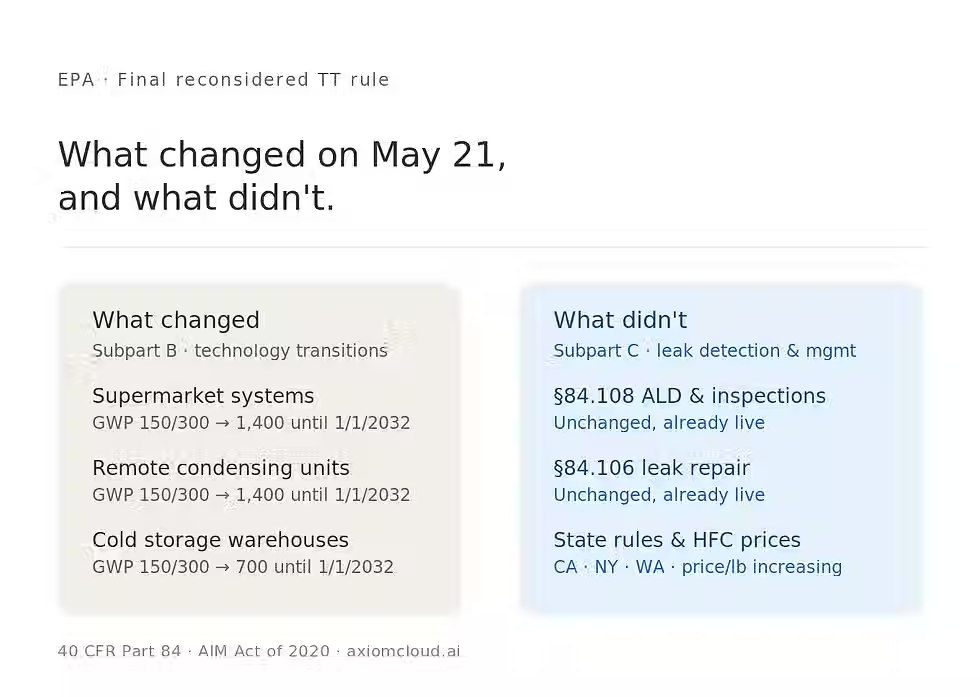
On May 21, 2026, EPA finalized its reconsideration of the Subpart B Technology Transitions Rule. New GWP installation thresholds for supermarket systems, remote condensing units, and cold storage warehouses were pushed to 2032. Some operators read that as broad regulatory breathing room on refrigerant compliance. It is not.
The reconsidered final rule touched Subpart B only. Subpart C — the ER&R Rule, with §84.106 leak repair and §84.108 ALD — was explicitly not amended. The January 1, 2026 (new equipment) and January 1, 2027 (existing 2017–2025 equipment) ALD deadlines stand. Operators waiting on a regulatory rollback that did not happen now have approximately 7 months until the existing-system deadline. (Don't gamble on a Trump reversal of the AIM Act.)
When is refrigerant leak detection required? (AIM Act deadlines)
New systems (≥1,500 lbs HFC charge): ALD required at installation, effective January 1, 2026 — already in effect.
Existing systems installed 2017–2025 (≥1,500 lbs HFC charge): ALD required by January 1, 2027 — approximately 7 months away as of mid-2026.
Pre-2017 equipment: Grandfathered from ALD retrofit. §84.106 leak repair obligations still apply if ≥15 lbs HFC charge.
Indirect ALD alert spec (§84.108(g)): Alert when measurements indicate refrigerant loss of 50 lbs or 10% of full charge, whichever is less.
Direct ALD alert spec (§84.108(f)): Sensors must detect ≥10 ppm and alert at ≥100 ppm vapor.
California operators: CARB Refrigerant Management Program imposes additional ALD requirements including quarterly inspection and 14-day follow-up — check both federal and state obligations.
Annual audit and calibration: Required for all ALD systems regardless of type.
For a deeper breakdown of the §84.108 rule and how it maps to existing equipment, see the EPA's cheat sheet on Automatic Leak Detection — decoded for facilities leaders, or January 1, 2026: when refrigerant leaks can trigger mandatory system retirements for the chronic-leaker reporting rule.
Questions to ask your ALD vendor
Before signing an ALD contract, every facilities, refrigeration, or compliance leader should ask:
Last calendar year, what percentage of confirmed leaks did your system detect before 50 lbs or 10% of system charge had leaked? What percentage were missed or caught late?
Last year, how many false-positive leak alerts did your system generate per site — and how was that number validated?
Can you produce per-site annual audit and calibration data on demand, by calendar year? (Auditor-grade ask — answer in hours, not weeks.)
Does your system monitor portions of the appliance located outside enclosed spaces — rooftop condensers, underground lines, overhead piping?
How many regulatory audits have you supported, and what documentation did you produce for those customers?
If those answers are not crisp, quantified, and credible, assume the system will increase compliance risk rather than reduce it.
Frequently asked questions
Does Axiom Cloud qualify as an ALD system under the AIM Act? Yes. The EPA's official Technical Support Document for the AIM Act ALD provisions identifies Axiom Cloud as one of only four manufacturers of commercially available indirect ALD products in the United States.
What is the difference between direct and indirect refrigerant leak detection? Direct ALD uses point-of-leak gas sensors that detect refrigerant vapor concentration. Indirect ALD monitors system performance — pressures, temperatures, runtimes, levels — and identifies leaks through behavioral signatures. Both are recognized under §84.108.
What is the AIM Act leak rate threshold for commercial refrigeration? 20% annual leak rate for commercial refrigeration, 30% for industrial process refrigeration, 10% for comfort cooling and other equipment under 40 CFR §84.106.
Can indirect ALD replace mandatory leak inspections under CAA Section 608? Yes. Per the EPA TSD, indirect ALD systems "can also be used as a compliance option in lieu of leak inspections under CAA section 608."
What refrigerant charge size triggers the AIM Act ALD requirement? Appliances with full charge ≥1,500 lbs of HFC (or substitute with GWP >53) in commercial refrigeration or industrial process refrigeration applications.
Compliance is mandatory. The wrong leak detection isn't.
The AIM Act ER&R Rule did not move. The May 21 reconsidered Technology Transitions Rule did not change the ALD deadline. Operators with ≥1,500 lb HFC systems installed between 2017 and 2025 have roughly 7 months to comply. The choice is no longer whether to deploy ALD — it is which kind. Sensor-only deployments leave coverage gaps and generate false positives that compound regulatory exposure. Whole-system indirect ALD covers every portion of the refrigerant circuit, satisfies the §84.108 alert spec, and is recognized by the EPA's own analysis as one of four qualifying solutions in the United States. When EPA enforcement of the existing-system deadline begins on January 1, 2027, your leak detection system will either be your best evidence — or your biggest liability.
California operators: the federal rules above are only half the obligation. California's CARB refrigerant management program has been stricter than the AIM Act since 2011 — a 14-day repair clock on every detected leak, no leak-rate threshold, and quarterly inspections unless a CARB-listed ALD is installed.
Sources:
1. EPA AIM Act — Subsection (h): Automatic Leak Detection Systems — Technical Support Document — U.S. EPA, September 2024
2. EPA Final Rule: Phasedown of Hydrofluorocarbons — Emissions Reduction and Reclamation — U.S. EPA, October 11, 2024 (89 FR 82682)
3. 40 CFR Part 84 Subpart C — Emissions Reduction and Reclamation Program — Code of Federal Regulations, current edition
4. EPA Final Rule: Phasedown of HFCs — Reconsideration of the Technology Transitions Rule (pre-publication) — U.S. EPA, signed May 21, 2026
5. Axiom Cloud Releases AI-Based Early Leak Detection Software, Tested at 242 Facilities — NaturalRefrigerants.com, 2024
6. CARB Refrigerant Management Program — California Air Resources Board, current edition


Comments